

To all my Irish American family and friends:
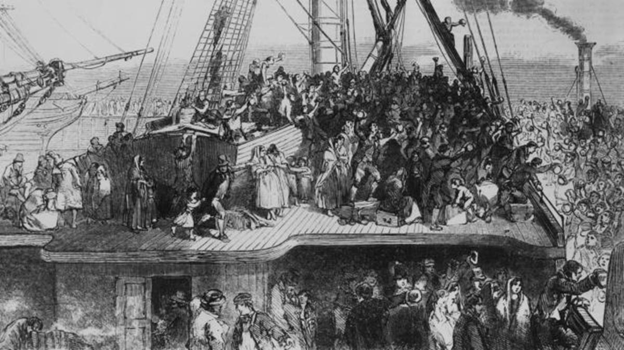
As you’re getting ready to paint shamrocks on your faces and get really hammered in a display of cultural pride, I’d like you to mull something over as you’re downing that Guinness. You are going to hear a bunch of noise from conservatives this week about an immigrant “surge” at our southern border. Try to keep in mind that the people arriving at our door today are no different than your Irish ancestors who came to America 150 years ago. Living conditions in their homeland has become so bad that they are willing to risk a long, life threatening journey to get to the US. They see the same hope in America that your forbearers saw when poverty and starvation was gripping the Emerald Isle.
When the Great Famine hit Ireland in the 1840s, ships by the thousand brought Irish refugees to the United States. It is estimated that 2 million Irish came to America during the famine years. In 1840 the total US population was only 17 million. Boston had 100,000 citizens and watched 37,000 Irish arrive at their docks. How’s that for a #surge? In 2018, as right-wing pundits cried of a border crisis, the percentage of the US population comprised of immigrants was 13.7%. Once the second wave of Irish hit after the Civil War, the immigrant population in America passed 14%, eventually peaking at just under 15% in the 1890s.
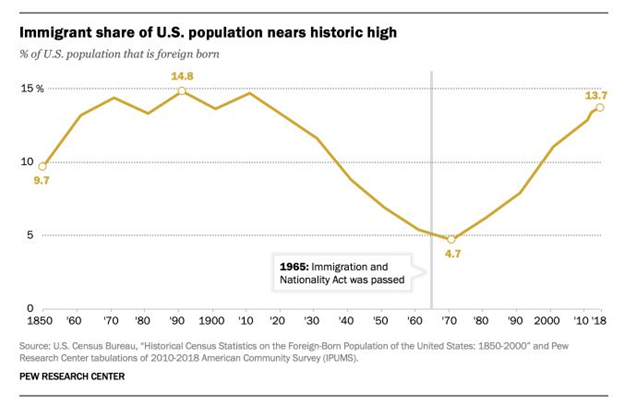
The main difference between today’s immigrants and your potato picking Great Grandpa is that your relatives were granted easy access to America. When the subject of Latin American immigration comes up, I always hear my relatives say, “Well our family came here legally.” The primary period of Irish immigration happened between 1840-1870, but the first immigration laws didn’t start showing up until 1875 and those were specifically designed to prevent Asian immigration. And ironically, many were pushed by recent Irish immigrants afraid of the Yellow Peril. It was easy for my relatives to come here “legally” since there were no laws. The legislation that really slams the door on immigration and created the concept of the “illegal immigrant” doesn’t happen until the 1930s. By this point the Irish are firmly entrenched in American society.
The truth is, if the current immigration laws had existed during the Great Irish Migration, there would be no St. Patrick’s Day parade for you to attend. Those boat loads of people would have been sent back to their famine-stricken homeland to starve. But instead, Irish citizens flocked to the US, built communities, and flourished. St. Patrick’s Day is not truly an Irish holiday anymore, it is an Irish American holiday. Back in the old country, the holiday is a quiet, somber affair, but here in America it is a raucous party. At its core, St. Patrick’s Day is a celebration that millions of Irish escaped deadly conditions and found a new home in America. And now every March 17th people fill the streets to proclaim “We’re here! We drink beer! Get used to it!”
Irish Americans did not have it easy of course; there was plenty of derision directed at the “dirty micks” stepping off the boat. However, there was no legal mechanism preventing the newcomers from building a life. European immigrants who arrived in the late 1800s never had to obtain a “green card”. They didn’t have to hire a smuggler to help them cross the border. They didn’t worry about US government agents showing up at their home or workplace to deport them. These are ideas that did not exist until the mid 20th century.
So, to all my Irish and wannabe Irish Americans, as you are hoisting a drink tomorrow and belting out “Whisky in the Jar” – Pour a little out in honor of the new immigrants who are huddled at the border right now, hoping for the same basic decency that your relatives received when they showed up at America’s door tired, hungry and in need of compassion.


 3am Cynic